
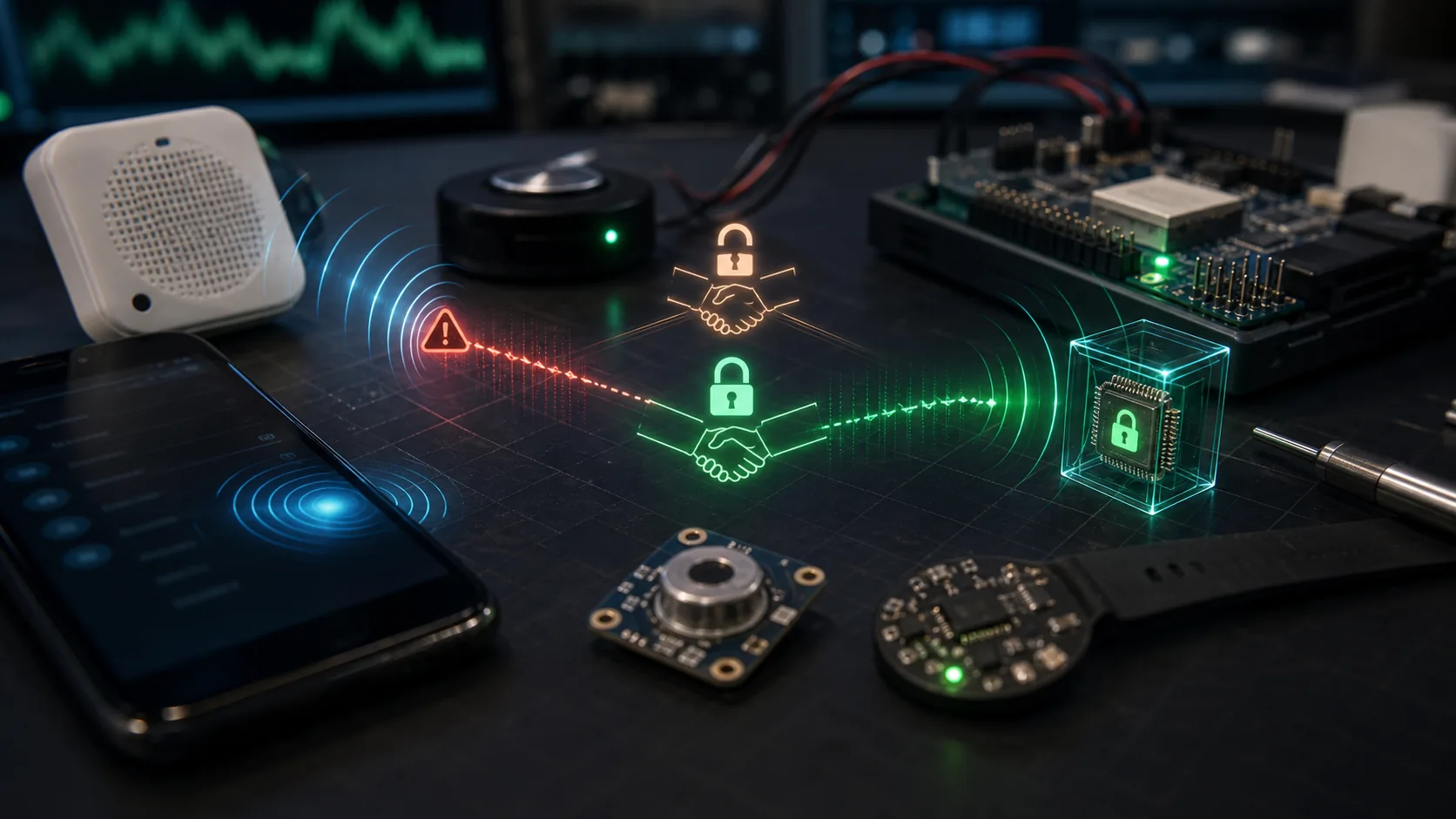
Why BLE Pairing Fails In Real Products
Bluetooth Low Energy devices often sit at the intersection of embedded constraints and enterprise expectations. The mobile app wants a frictionless onboarding flow, the firmware wants low power and low memory use, and the security model still has to resist interception, impersonation, and unauthorized control.
Modes such as Just Works can be appropriate for low-risk devices, but they do not provide meaningful protection against man-in-the-middle scenarios. Stronger options require better UX, device identity, and operational planning.
Common Mistakes
- Using Just Works for devices that control sensitive data, physical access, payments, or regulated workflows.
- Assuming BLE encryption compensates for weak identity or poor authorization inside the application protocol.
- Shipping static PINs, shared keys, or factory defaults that cannot be rotated in the field.
- Ignoring downgrade behavior and key negotiation issues such as KNOB-style risk patterns.
- Treating OTA updates as an afterthought instead of a core security control.
Designing For Enterprise Deployment
Enterprise BLE products need clear device identity, authenticated firmware, secure provisioning, least-privilege mobile access, signed OTA packages, and telemetry that helps detect pairing abuse or unexpected reconnect patterns.
How Xari Helps
Xari can support the full connected-product vertical: mobile app, embedded firmware, cloud API, provisioning flow, OTA strategy, and security review. That end-to-end view is what keeps BLE decisions aligned with the business risk.
Pairing Decisions Affect The Whole Product
Pairing is not only a radio-level choice. It influences the mobile onboarding experience, cloud registration, device ownership transfer, support workflows, manufacturing provisioning, field replacement, and incident response.
A secure design needs to answer what happens when a phone is lost, a device is resold, an employee leaves, a fleet credential is exposed, or an OTA update changes the pairing behavior.
Design Review Checklist
- Does the pairing method provide protection against man-in-the-middle attacks for the product risk level?
- Are device identities unique, verifiable, and tied to cloud authorization?
- Can credentials be rotated without replacing hardware?
- Are BLE characteristics protected with appropriate permissions?
- Can firmware updates be signed, verified, rolled back safely, and audited?
- Does the mobile app enforce user authorization after a successful BLE connection?
Testing Beyond The Happy Path
BLE security tests should include reconnect behavior, bonding deletion, factory reset, failed pairing attempts, downgraded security modes, firmware update interruption, and attempts to issue privileged commands from an unauthorized mobile device.
Those tests are especially important when products move from prototype boards to production hardware and real customer environments.
Operational Considerations
Connected devices live longer than normal software releases. Teams need telemetry, fleet visibility, update strategy, and support procedures so they can respond when a pairing flaw, firmware issue, or mobile compatibility problem appears in the field.
Adapted and reframed from the Security Factor 365 article: BLE Pairing Pitfalls: Just Works, KNOB, and LESC.
Related Services
Mobile Development | Firmware Development | Security | IoT Solutions
