
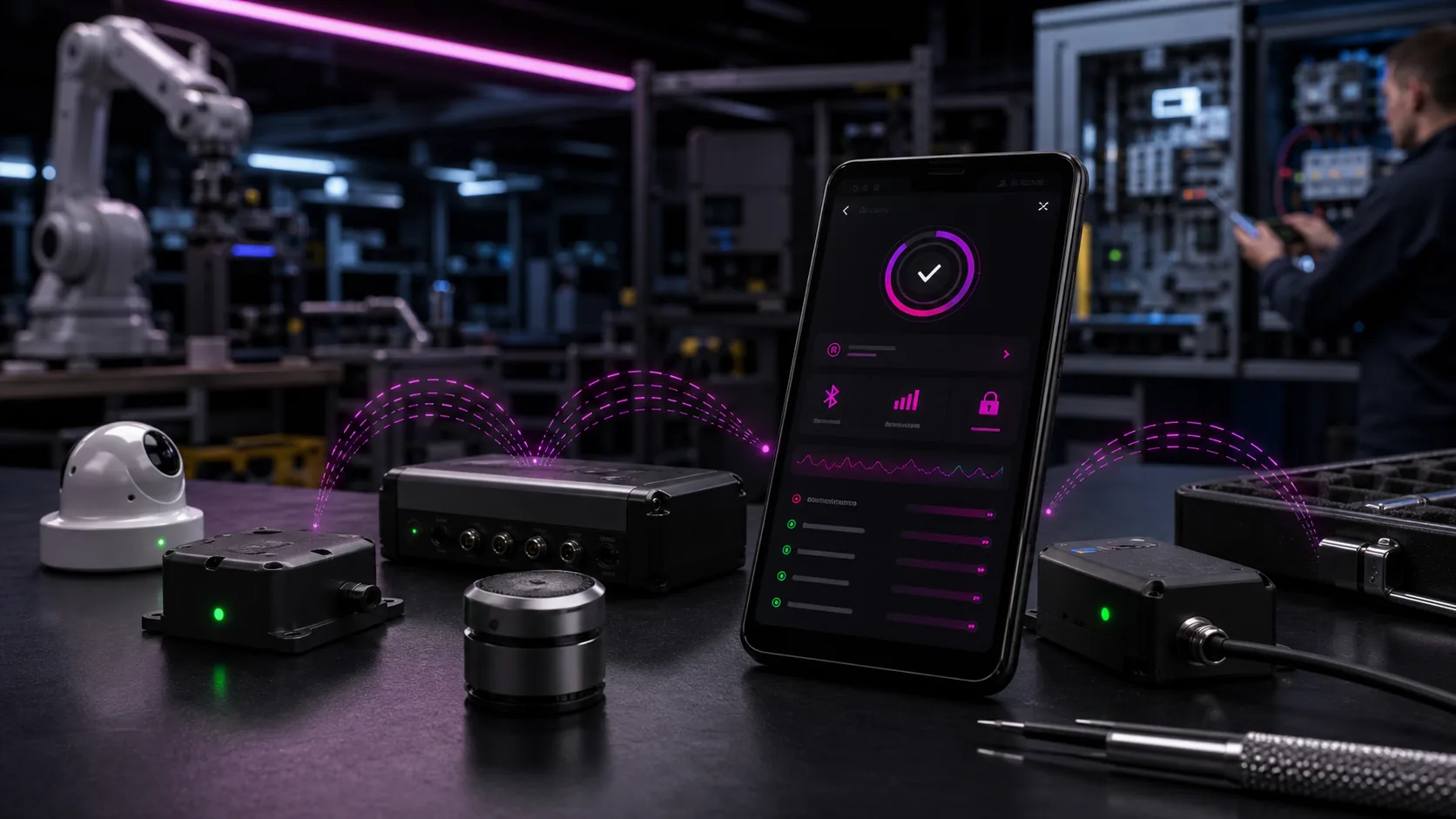
Bluetooth Low Energy can look deceptively simple during a prototype. A phone discovers a device, connects, reads a characteristic, writes a command, and the demo works. Enterprise products are different. They operate across iOS and Android versions, different phone manufacturers, multiple firmware revisions, support teams, field technicians, security requirements, and real customers who expect the product to recover when the radio environment is imperfect.
At Xari, we approach BLE mobile development as part of a connected product system. The mobile app, firmware, backend, support tooling, diagnostics, and security model all influence whether the product is reliable after deployment.
Why BLE reliability matters in enterprise products
For connected products, BLE often becomes the first operational touchpoint. It may be used for setup, device identification, secure commands, diagnostics, calibration, firmware version checks, or field-service workflows. If that first interaction is fragile, the rest of the product feels fragile too.
The business impact shows up quickly: support tickets increase, technicians lose time, users repeat setup steps, and teams struggle to determine whether a failure came from the app, the phone, the device, the firmware, or the environment.
Android and iOS do not behave the same
A production BLE app has to respect the differences between platforms. Android exposes more of the GATT stack and requires more explicit connection management. MTU negotiation, service discovery, cleanup after errors, and Bluetooth stack recovery need deliberate handling. iOS hides more of the lower-level details, but pairing state and system-level decisions can still create confusing failure cases.
That means a single happy-path abstraction is rarely enough. The app needs platform-aware behavior for connection attempts, permissions, pairing prompts, timeouts, user cancellation, and recovery instructions.
Connection state must be designed, not improvised
Many BLE issues come from race conditions. One part of the app starts connecting while another part starts scanning or tries to write to a characteristic before service discovery is complete. The result can be random-looking failures that are hard to reproduce.
For enterprise apps, we prefer an explicit connection state model that tracks scanning, connecting, connected, service discovery, operation queue, subscription state, and disconnect cleanup. The app should prevent duplicate connection attempts and serialize operations per device. BLE does not reward parallel reads and writes against the same peripheral.
Pairing and permissions need user-ready recovery paths
Pairing failures should not be presented as cryptic Bluetooth errors. The app should translate platform failures into clear next steps. If a device has forgotten a bond but the phone still remembers it, the user may need to remove the device from system Bluetooth settings and pair again. If a permission is denied, the app should explain what permission is needed and why.
This is especially important for field teams. A technician should not have to know Android GATT codes or iOS pairing internals to recover from a common device state mismatch.
Retries need rules
Retrying everything is not reliability. It can drain battery, lock up the Bluetooth stack, and hide real problems. Some errors are temporary and deserve backoff. Others, such as cancelled pairing or a known pairing mismatch, require user action instead of another automated attempt.
A practical strategy separates recoverable connection timeouts from authentication failures, explicit user disconnects, firmware-side resets, and out-of-range conditions. It also gives the Bluetooth stack time to recover before reconnecting, especially on Android.
Security cannot be bolted on later
BLE may carry sensitive commands, provisioning data, device identifiers, or customer-specific information. Enterprise systems need a clear security model for what travels over BLE, how keys are stored, when encryption is required, and how the app behaves when secure material is missing.
Our rule is simple: sensitive operations should fail clearly rather than silently falling back to insecure transmission. Debug convenience cannot become a production security hole.
Diagnostics are part of the product
A reliable BLE implementation logs useful state transitions without overwhelming production telemetry. Device identifier, connection attempt number, platform, OS version, firmware version, error category, retry decision, and elapsed time can turn a vague support issue into a solvable engineering problem.
For enterprise teams, diagnostics also support lifecycle decisions: which firmware versions fail more often, which phone models behave differently, and where support documentation should be improved.
What Xari looks for in a production BLE app
- Platform-aware connection and permission handling for Android and iOS.
- A single source of truth for device connection state.
- Serialized GATT operations and guarded connection attempts.
- Clear recovery flows for pairing, out-of-range devices, Bluetooth resets, and user cancellation.
- Secure storage and explicit rules for encrypted operations.
- Telemetry that helps support and engineering teams diagnose failures.
- Testing across OS versions, device manufacturers, backgrounding, interruptions, low battery, and firmware resets.
Where this fits in Xari projects
BLE work often crosses several disciplines. The mobile app needs a stable user experience. Firmware needs predictable services, characteristics, error behavior, and versioning. IoT systems may need telemetry, fleet visibility, provisioning, and OTA coordination. Security needs to protect the device and the data path.
That is why we treat BLE as a connected-product workflow, not just a mobile feature.
Related Xari services
Mobile Development · IoT Solutions · Firmware Development · Security
Adapted from engineering notes originally published at xafmarin.com.
