
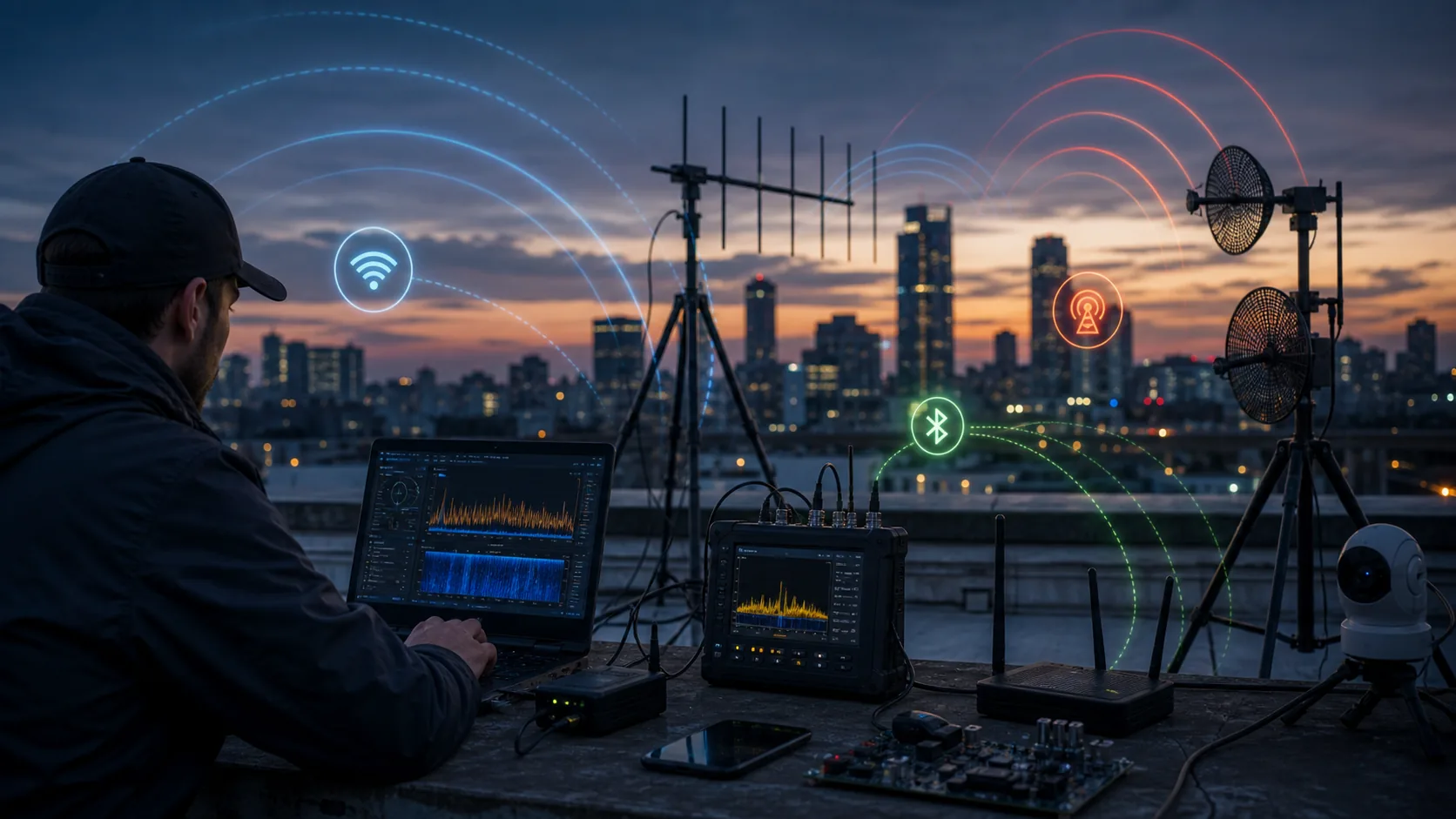
Wireless Is An Application Boundary
Many teams secure the web portal and API but treat Wi-Fi, Bluetooth, and RF behavior as implementation detail. For IoT and embedded products, those wireless interfaces are often the first point of contact with attackers.
The real surface includes device onboarding, local commands, pairing, credential storage, firmware update behavior, cloud authorization, mobile app permissions, and operational monitoring.
Attack Surfaces To Review
- Wi-Fi provisioning: temporary access points, captive flows, credential transfer, and reset behavior.
- Bluetooth: pairing mode, identity, authorization, replay resistance, and local command control.
- RF protocols: signal replay, jamming assumptions, weak encoding, and physical proximity attacks.
- Firmware: debug ports, update trust, rollback, secrets, and hardware identity.
- Cloud APIs: device authorization, telemetry integrity, command queues, and tenant isolation.
What Enterprise Teams Need
Wireless security should be planned with the same discipline as web and cloud security: architecture review, field testing, secure defaults, logging, repeatable release gates, and documented response paths when deployed devices need remediation.
How Xari Helps
Xari brings software, mobile, firmware, cloud, and security together so connected-product risks are not split across disconnected teams. We can help validate the full vertical from device behavior to enterprise operation.
Field Conditions Change The Threat Model
Wireless behavior is highly contextual. Signal range, antenna placement, enclosure design, interference, pairing windows, installation location, and technician workflows can all change the practical risk.
That is why connected-product security should combine architecture review with field-style testing. A design that looks controlled on a desk may behave differently in a warehouse, vehicle, hospital, factory, or public space.
Testing Scenarios To Include
- Device provisioning from a clean state, a failed state, and a factory reset state.
- Unauthorized mobile clients attempting discovery, pairing, and command execution.
- Replay or repeated command attempts against local wireless protocols.
- Credential extraction attempts from mobile apps, firmware images, and debug interfaces.
- Cloud command authorization when the local device connection is valid but the user is not.
Cloud And Wireless Must Agree
A local connection should not automatically imply business authorization. The cloud, mobile app, and device firmware need a consistent model for identity, ownership, role, tenant, and command permissions.
When those layers disagree, attackers can exploit the weakest boundary even if the radio protocol itself is configured correctly.
Documentation For Long-Term Support
Teams should document supported radios, pairing assumptions, provisioning paths, recovery flows, firmware signing, device certificates, and incident response steps. That documentation becomes critical when products are deployed for years.
Adapted and reframed from the Security Factor 365 article: Hacking inalambrico: Wi-Fi, Bluetooth y RF.
